
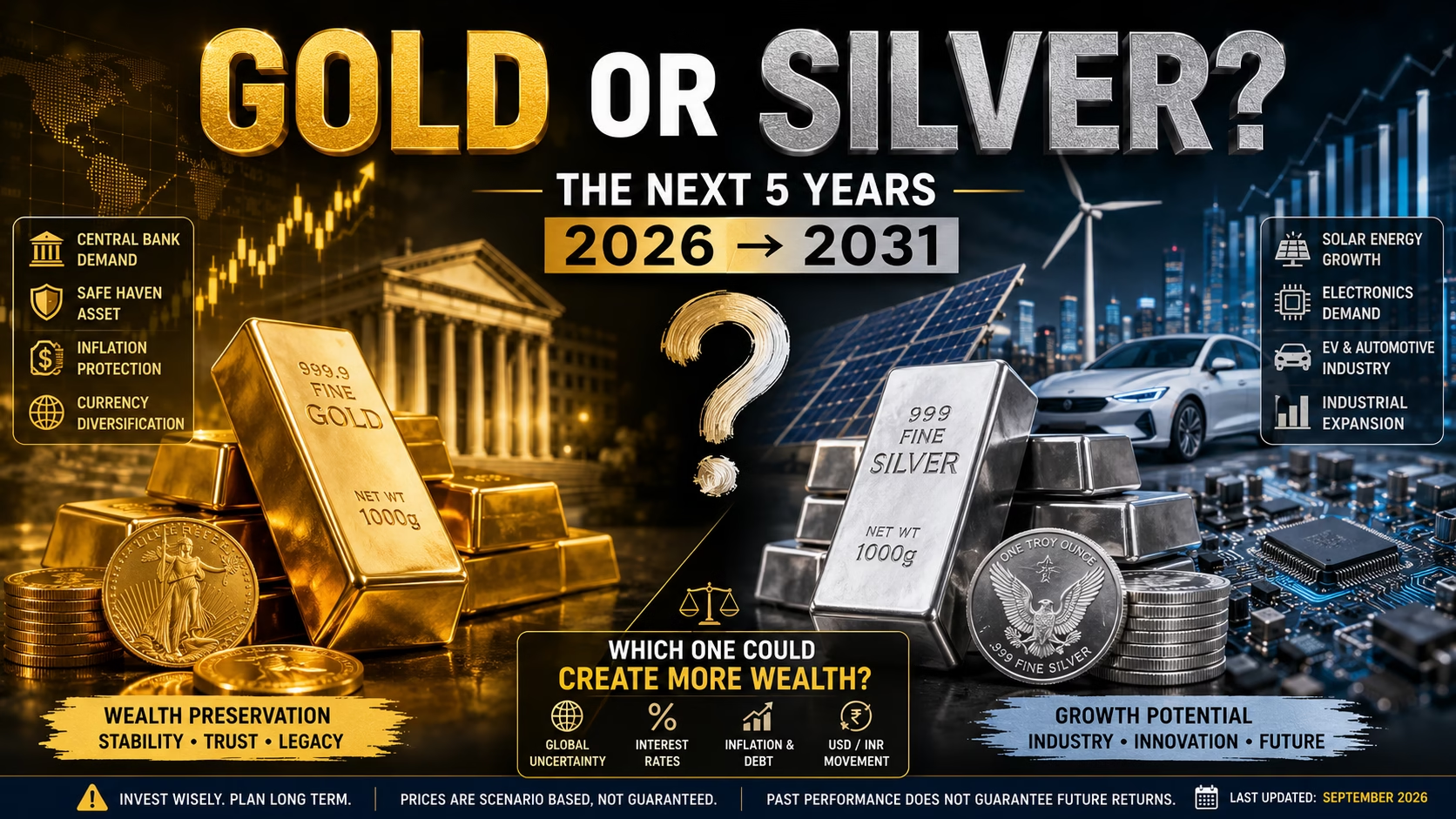

Gold or Silver for Next 5 Years: A 2026–2031 Investor’s Guide
Gold and silver have always fascinated investors.
But in 2026, the question is no longer simply “Should I buy gold?”
The more interesting question is:
If I have money to invest for the next five years, should I choose Gold or Silver?
The answer is not as simple as choosing the metal that has the higher price prediction.
The global financial environment is changing rapidly. Geopolitical tensions, government debt, inflation, interest rates, central-bank buying, de-dollarisation, renewable energy, electric vehicles and growing industrial demand are all influencing precious metals.
And this creates an interesting situation:
Gold is increasingly becoming a global financial safety asset, while silver is becoming both a precious metal and an industrial commodity.
So, which one could perform better between 2026 and 2031?
Let’s understand.
Gold vs Silver: The Basic Difference
Before looking at the next five years, it is important to understand that gold and silver behave differently.
| Gold | Silver |
|---|---|
| Primarily a monetary and investment asset | Monetary + industrial asset |
| Lower volatility compared with silver | Much higher volatility |
| Strong safe-haven demand | Strong industrial demand |
| Central banks are major buyers | Industrial users are major consumers |
| Used extensively for wealth preservation | Used extensively in electronics, solar, automobiles and other technologies |
| Generally more defensive | Generally more aggressive |
In simple words:
Gold is more about protecting wealth.
Silver is more about combining wealth protection with growth potential.
Why Could Gold Continue to Rise?
The biggest argument for gold over the next five years is not jewellery demand.
It is global financial uncertainty.
1. Central Banks Are Buying Gold
One of the most important structural developments in the gold market has been continued central-bank demand.
Countries are increasingly interested in diversifying their reserves and reducing dependence on any single currency.
Several analysts surveyed by the London Bullion Market Association continue to identify central-bank buying and reserve diversification as important structural supports for gold.
This is important because central banks are generally not short-term traders.
They buy gold as a strategic reserve asset.
2. Global Government Debt Is a Long-Term Concern
Governments around the world are carrying enormous amounts of debt.
If debt continues to grow faster than economies, governments may face difficult choices involving:
- Higher taxes
- Spending cuts
- Higher inflation
- Financial repression
- Currency depreciation
- Lower real interest rates
Gold has historically benefited when investors become concerned about the purchasing power of currencies.
This doesn’t mean a debt crisis is guaranteed.
But it does mean that gold can continue to play an important role as a portfolio hedge.
3. Geopolitical Tensions
The world is becoming increasingly fragmented.
Trade disputes, wars, sanctions, energy-security concerns and tensions between major economic powers can all increase demand for safe-haven assets.
When uncertainty rises, investors often look for assets that don’t depend on the financial health of a particular company or government.
Gold fits that role exceptionally well.
Recent market commentary continues to highlight geopolitical risk, fiscal uncertainty and monetary policy as major drivers of gold prices.
4. What Happens If Interest Rates Fall?
Interest rates are another major factor.
Gold doesn’t pay interest.
Therefore, when interest rates and bond yields are very attractive, investors may prefer interest-bearing assets.
But when interest rates fall — particularly if inflation remains elevated — gold becomes relatively more attractive.
The equation can look like this:
Lower interest rates → Lower opportunity cost of holding gold → Higher potential demand for gold
However, this relationship is not perfect. Gold can sometimes rise even when yields remain high if geopolitical and reserve-diversification demand is strong.
And Then There Is the Indian Rupee
This is something Indian investors should never ignore.
Gold is internationally priced largely in US dollars.
Indian investors effectively face two variables:
International Gold Price + USD/INR
Suppose international gold rises by 5%, while the rupee depreciates by another 4% against the dollar.
The INR price of gold could potentially rise by roughly 9%, before accounting for local market factors.
Therefore, even if international gold delivers a moderate return, Indian investors can potentially see stronger returns in rupee terms if the rupee weakens.
Now Comes the Interesting Part: Silver
If gold is the defensive player, silver is the high-potential player.
And there is a very important reason.
Silver isn’t just a precious metal.
It is also an industrial metal.
Silver is used in areas such as:
- Electronics
- Solar energy
- Electric vehicles
- Automotive applications
- Data centres
- Electrical equipment
- Various high-tech applications
The LBMA’s 2026 analyst survey highlights electronics, renewable energy, automobiles and data centres among important sources of industrial silver demand.
This gives silver a completely different growth story from gold.
The Silver Opportunity
Imagine the world continuing to invest heavily in:
Solar + EVs + Electronics + AI + Data Centres + Electrification
All of these trends require enormous amounts of electrical infrastructure and technology.
Silver’s industrial applications give it exposure to this transformation.
At the same time, silver can benefit from the same monetary and geopolitical factors that support gold.
That creates an interesting combination:
Silver can potentially benefit from both economic growth and monetary uncertainty.
But there is a catch.
Silver Can Be Brutal
Silver is significantly more volatile than gold.
When investors become optimistic, silver can rise extremely quickly.
But when sentiment changes, it can fall just as aggressively.
The smaller and less liquid silver market tends to exaggerate both upside and downside moves. LBMA analysts specifically describe silver as highly volatile because of its dual monetary and industrial role.
Recent 2026 price action is a good reminder of this volatility, with silver experiencing very large swings during the year.
Therefore:
Don’t buy silver simply because you expect it to outperform gold.
You must be comfortable with substantial corrections.
Gold vs Silver: 5-Year Outlook
So what could happen between 2026 and 2031?
Rather than predicting one magical number, it is better to think in scenarios.
Gold — Possible INR Scenario
| Year | Possible Gold Range* |
|---|---|
| 2026 | Rs. 1.40–1.70 lakh / 10g |
| 2027 | Rs. 1.50–1.85 lakh |
| 2028 | Rs. 1.60–2.00 lakh |
| 2029 | Rs. 1.70–2.20 lakh |
| 2030 | Rs. 1.85–2.40 lakh |
| 2031 | Rs. 2.00–2.70 lakh / 10g |
Silver — Possible INR Scenario
| Year | Possible Silver Range* |
|---|---|
| 2026 | Rs. 2.0–3.0 lakh / kg |
| 2027 | Rs. 2.3–3.3 lakh |
| 2028 | Rs. 2.5–3.8 lakh |
| 2029 | Rs. 2.8–4.2 lakh |
| 2030 | Rs. 3.0–4.8 lakh |
| 2031 | Rs. 3.3–5.5 lakh / kg |
These are scenario ranges for educational and planning purposes, not guaranteed price targets. Actual Indian prices will also depend on international prices, USD/INR, taxes, duties, local premiums and market conditions.
Three Possible Futures
Instead of asking “What will gold be worth in 2031?”, a smarter investor should ask:
What happens if the world takes different paths?
🟢 Scenario 1: The Bull Market Continues
Suppose we experience:
- Persistent inflation
- Geopolitical instability
- Strong central-bank gold purchases
- Continued currency diversification
- Lower real interest rates
- Strong industrial demand
In this environment:
Gold could potentially reach:
Rs. 2.7–3.2 lakh/10g
Silver could potentially reach:
Rs. 5–6.5 lakh/kg
Silver could significantly outperform gold in this scenario.
🟡 Scenario 2: The Base Case
Suppose we see:
- Moderate inflation
- Continued central-bank demand
- Gradual rupee depreciation
- Normal economic growth
- Continued industrial silver consumption
Then a reasonable planning scenario could be:
Gold:
Rs. 2.0–2.7 lakh/10g
Silver:
Rs. 3.3–5.5 lakh/kg
This is the scenario I would use for long-term financial planning rather than assuming an extreme bull market.
🔴 Scenario 3: The Bear Case
What if inflation falls significantly?
What if interest rates remain high?
What if geopolitical tensions reduce?
What if the US dollar remains strong?
In that environment, precious metals could experience a significant correction.
A possible scenario could be:
Gold:
Rs. 1.5–1.9 lakh/10g
Silver:
Rs. 2.2–3.2 lakh/kg
Notice something interesting:
Silver’s downside range is much wider.
That’s the price you pay for its higher potential return.
So, What Should You Buy?
Now we come to the most important question.
If your priority is wealth protection:
🥇 GOLD
Gold is generally the better choice.
It has:
- Lower volatility
- Stronger safe-haven characteristics
- Central-bank demand
- Long history as a store of value
- Less dependence on industrial demand
If your priority is higher potential growth:
🥈 SILVER
Silver could offer greater upside.
But you must be prepared for:
30%, 40% or even larger corrections during certain market cycles.
Silver is not for investors who panic when prices fall sharply.
Why Not Buy Both?
Perhaps the most sensible answer isn’t:
Gold OR Silver
It could be:
Gold AND Silver
For someone who wants exposure to precious metals over the next five years, one possible approach could be:
60–70% Gold
30–40% Silver
This gives the portfolio a defensive foundation through gold while allowing silver to provide additional growth potential.
The exact allocation, of course, should depend on your overall portfolio, risk tolerance, investment horizon and financial goals.
Should You Invest All the Money at Once?
This is another important question.
After such a strong rise in precious metals, investing the entire amount on a single day can expose an investor to timing risk.
Instead, investors may consider staggered buying.
For example:
Rs. 5 lakh investment
Rather than investing Rs. 5 lakh immediately:
Rs. 1 lakh → Now
Rs. 1 lakh → After a correction
Rs. 1 lakh → Over the next few months
Rs. 1 lakh → During another significant correction
Rs. 1 lakh → Kept for an opportunity
The objective isn’t to perfectly predict the bottom.
Because, frankly:
Nobody consistently knows where the bottom is.
The objective is to build the position without becoming overly dependent on one entry price.
The Biggest Mistake Investors Can Make
Don’t look at gold and silver only through the question:
“How much will the price increase?”
Instead ask:
Why am I buying it?
Is it for:
- Wealth protection?
- Portfolio diversification?
- Long-term growth?
- Inflation protection?
- Retirement planning?
- Children’s future?
- A five-year financial goal?
The answer can completely change whether gold or silver is appropriate.
Gold or Silver: My 5-Year Verdict
If I had to simplify the entire discussion into one table:
| Factor | Gold | Silver |
|---|---|---|
| Wealth protection | ⭐⭐⭐⭐⭐ | ⭐⭐⭐ |
| Stability | ⭐⭐⭐⭐⭐ | ⭐⭐ |
| Safe-haven demand | ⭐⭐⭐⭐⭐ | ⭐⭐⭐ |
| Industrial growth | ⭐⭐ | ⭐⭐⭐⭐⭐ |
| Volatility | ⭐⭐⭐⭐ | ⭐⭐ |
| Upside potential | ⭐⭐⭐⭐ | ⭐⭐⭐⭐⭐ |
| Central-bank demand | ⭐⭐⭐⭐⭐ | ⭐ |
| Suitable for conservative investors | Yes | Limited |
| Suitable for aggressive investors | Yes | Yes |
The Final Answer
So, what should you buy for the next five years — Gold or Silver?
My answer is:
Don’t think of Gold and Silver as competitors. Think of them as two different tools.
Gold is the shield.
Silver is the spear.
Gold can help protect purchasing power during periods of inflation, geopolitical uncertainty and financial instability.
Silver offers exposure to those same monetary themes while also benefiting from the long-term growth of electronics, renewable energy, electrification and other industrial applications.
Therefore, for a five-year precious-metals strategy, a combination of Gold and Silver may make more sense than choosing only one.
If your priority is safety:
Gold
If your priority is aggressive growth:
Silver
If you want a balance between the two:
Gold + Silver
And perhaps the most important lesson is this:
Don’t try to predict the perfect price. Build your investment strategy around the future you are preparing for.
Final Thought
The next five years could be very different from the last five.
Currencies may change.
Interest rates may change.
Geopolitical alliances may change.
Technology may change.
But one thing is likely to remain true:
People and institutions will continue looking for ways to preserve and grow their wealth.
And that is precisely why Gold and Silver will remain relevant in the global financial system.
You can also read:
Why Most Indians Fail at Financial Planning? How You Can Win?
Why Your Rs. 1 Crore Retirement Target Is a Joke in 2025?
Disclaimer: This article is for educational and informational purposes only and should not be considered investment advice. Precious metals can be highly volatile, and past performance does not guarantee future returns. Investors should consider their financial goals, risk tolerance and overall asset allocation before investing.
FAQ
Gold is generally better suited for investors prioritising wealth preservation and lower volatility, while silver may offer greater upside potential but comes with substantially higher volatility. A combination of both can provide a more balanced precious-metals allocation.
It is possible under favourable long-term conditions, but no price target can be guaranteed. Gold’s future INR price will depend on international gold prices, the US dollar, the Indian rupee, interest rates, inflation, central-bank demand and geopolitical conditions.
Silver has the potential to outperform gold because of its industrial applications in areas such as electronics, solar energy and electrification. However, silver is also significantly more volatile, so higher potential returns come with higher risk.
Generally, yes. Silver’s smaller market and substantial industrial component can produce much larger price movements than gold. Recent 2026 trading has demonstrated this clearly.
For investors who want exposure to precious metals, combining the two can make sense because they serve different purposes. Gold can provide the defensive component, while silver can provide additional growth potential.
It depends on the objective. Investors should consider factors such as making charges, purity, storage, liquidity, taxation and the form of investment. Financial products such as ETFs or other regulated investment vehicles may have different characteristics from physical metals.
Nobody can reliably predict the exact bottom. Instead of making an all-or-nothing timing decision, investors may consider staggered purchases according to their financial plan and risk tolerance.